Cools on solar. Never leaves you sweating.
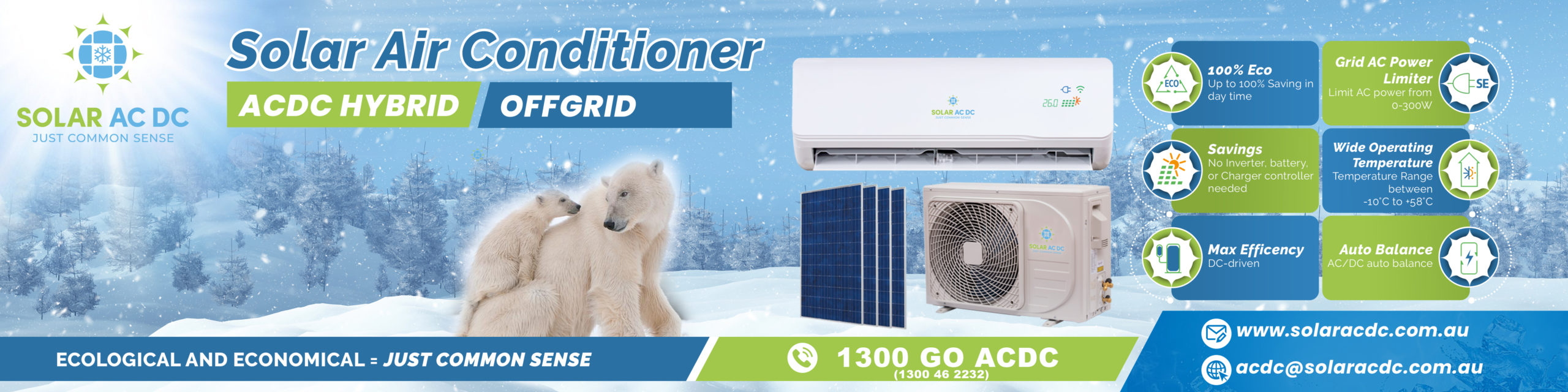
Runs directly on solar power when there is enough sunlight, and mixes in battery or grid power at night or when production drops. Six system types, from a plug-and-play DIY split to a four-zone multihead.
via the smart AC limiter
Why hybrid wins
Efficient where it counts, kinder on the planet, and it does not drop the ball when the sun does.

Efficient
Runs directly on solar while the sun is up, with a smart AC limiter keeping grid draw down to as little as 300W when it does need topping up.

Eco friendly
R32 refrigerant with a lower environmental impact, and integrated solar power that cuts the carbon footprint of the hours you use it most.

High performance
Brushless DC motors for quiet running and maximum energy savings, and reliable cooling across a wide operating temperature range.
Solar first, grid only if it has to
The unit decides, moment to moment, where its power comes from. You never touch a switch and you never lose cooling.
Auto start on sunlight
Once there is enough sun on the array the system starts itself and runs directly on solar power. No scheduling, no switching over by hand.
Built-in MPPT
Maximum Power Point Tracking keeps pulling the most available power out of the panels as light and heat change through the day.
Mixes in battery or grid
At night or when solar production drops it blends in battery or grid power without interrupting the cooling. You do not notice it happen.
Smart AC limiter
A grid AC limiter caps how much mains power the unit may draw — as little as 300W when necessary, and it cuts night-time grid load.
A fully off-grid unit needs enough panels and storage to cover the worst day of the year. A hybrid only needs to cover the good ones and lets the grid quietly fill in the rest — which is why it costs less to install and still does most of its work on sunshine.
Six systems, one power source
From a plug-and-play DIY split to a four-zone multihead — the right shape for the building, all running solar first.

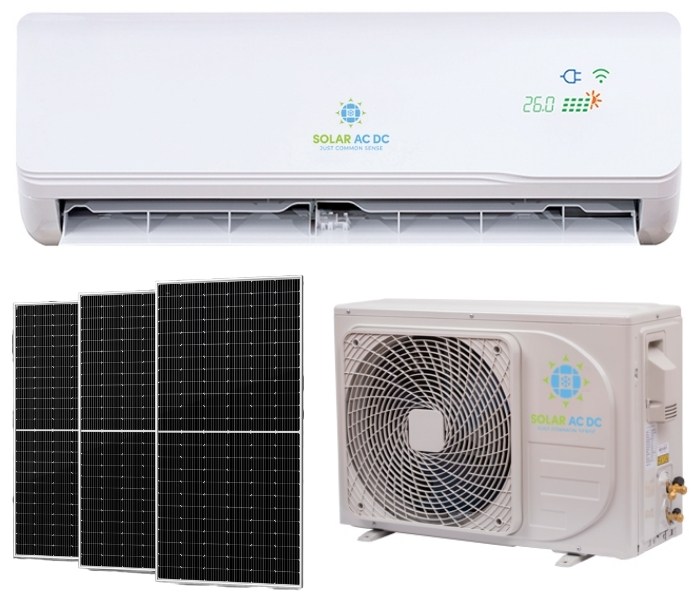
The standard hybrid split, in three sizes
Runs directly on solar power whenever there is sufficient sunlight, then mixes in battery or grid power at night or during low solar production.
- Operates in off-grid and on-grid scenarios
- Smart grid AC limiter keeps consumption minimal — as little as 300W when necessary
- Available in 3.5 kW, 5 kW and 7 kW
- Also available as DIY models

Runs on solar through daylight, whole home
Operates in both off-grid and on-grid environments, running on solar during daylight and switching automatically at night.
- Available in 5 kW and 7 kW
- Switches to solar plus battery/grid, or solely battery/grid, at night
- Brushless DC motors for quieter operation and maximum energy savings
- Wide operating range: -10°C to +55°C
- Reliable cooling without interruption

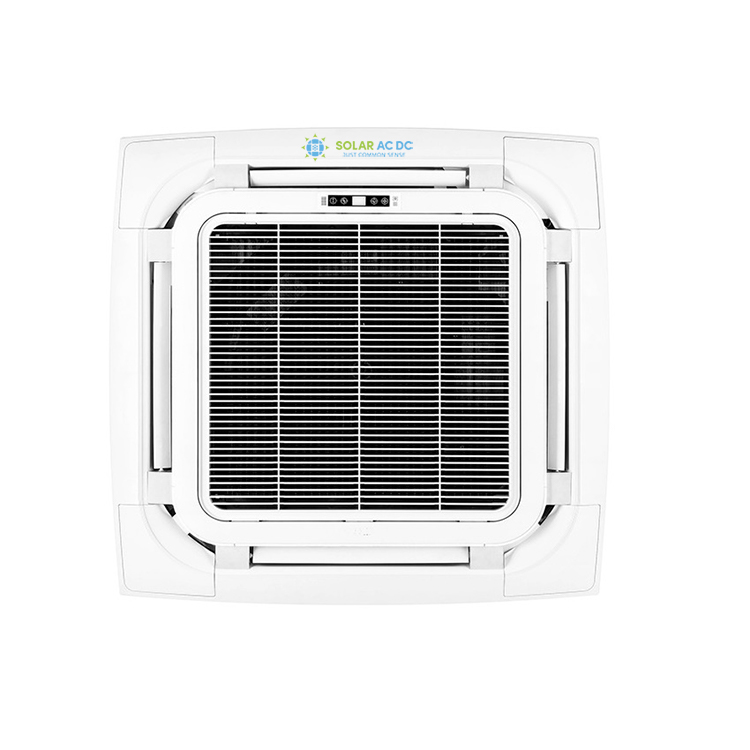
360-degree airflow at as little as 26 dB
Equipped to run entirely on solar power during the day, switching seamlessly between solar and battery or grid power when necessary.
- Optimised for maximum efficiency at ambient temperatures up to +55°C
- Eco-friendly R32 refrigerant with lower environmental impact
- Indoor units produce as little as 26 dB of noise
- 360-degree air distribution for uniform cooling
- Built-in Wi-Fi control for remote management and energy monitoring
- Supports timer settings for optimal usage

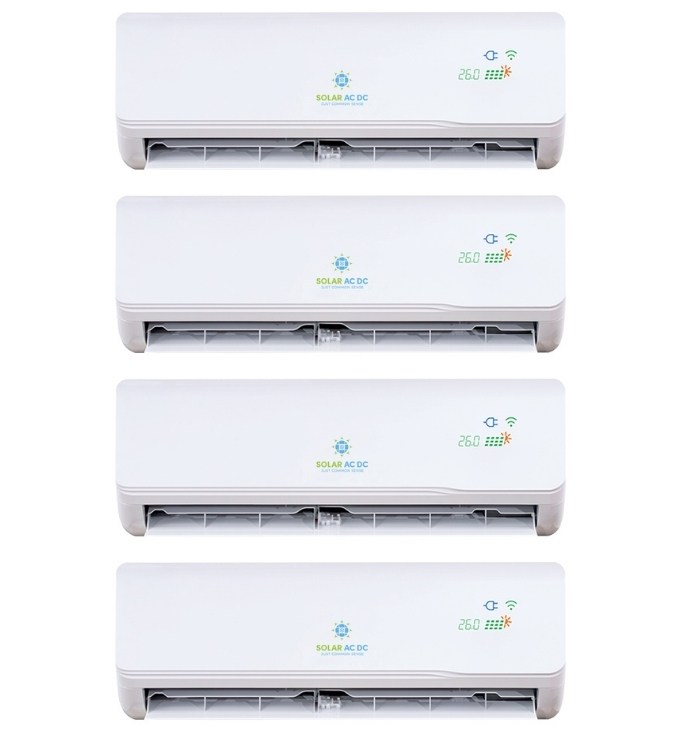
One outdoor unit, up to four indoor heads
Flexible multi-zone cooling from a single outdoor unit — mix and match indoor heads to suit the rooms you actually use.
- 8 kW (3-zone) with up to three indoor heads
- 10.5 kW (4-zone) with up to four indoor heads
- Mix and match from 3.5 kW, 5 kW and 7 kW indoor units
- Built-in MPPT solar control, automatic restart and AC limiting
- Brushless DC motors for whisper-quiet operation
- Remote control and Wi-Fi app management
- STC eligibility on panels · reduces night-time grid load

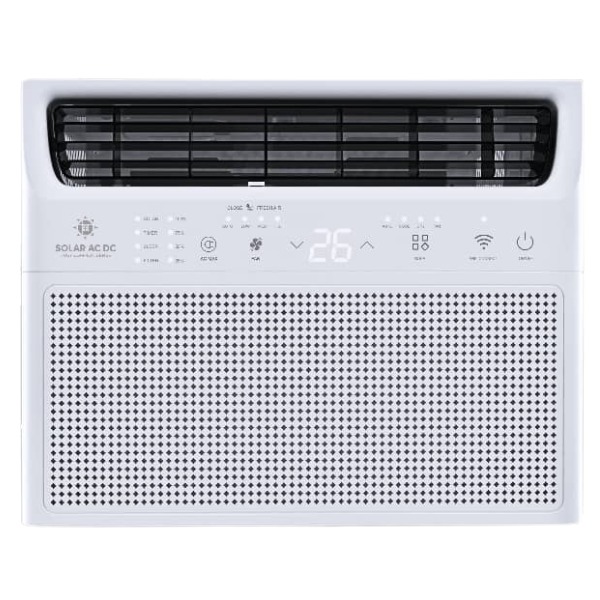
All in one, and no inverter required
A single 3.5 kW window unit with DC inverter technology and nothing else to install — no inverter needed for solar operation.
- Eco-friendly R32 refrigerant and brushless DC motors
- Noise levels below 56 dB
- Intelligent AC limiter minimises grid use at night
- Wi-Fi enabled for remote monitoring and control
- STC eligibility for solar panel rebates
- Auto-start when sunlight is available
- Plug-and-play setup with no external piping
Installed, not rendered
Splits, DIY units, ducted and cassette systems in the field. Tap any photo to enlarge.
Product and installation photography courtesy of Solar ACDC.
The numbers that actually matter
Specifications vary by system type — these are the highlights across the range.
Minimum grid draw
The smart AC limiter caps how much mains power the unit may take.
Cassette at its quietest
Quiet enough that you stop noticing it is on.
Ducted operating range
Reliable operation across the full spread of Australian conditions.
Refrigerant
Lower environmental impact than the older gases still in circulation.
Built in
Solar tracking inside the unit, not a separate box on the wall.
App control & monitoring
Set it and watch what it is consuming without getting up.
Motors
Fewer wear parts and better efficiency than a brushed motor.
Rebate eligible
The window hybrid supports STC eligibility for solar panel rebates.
Brochures & installation manuals
Everything a builder, sparkie or specifier will ask for, in one place.
Documents are published by the manufacturer, Solar ACDC. Host your own copies in the MinSolar Media Library if you would rather not depend on external links, and check each document is the current revision before sending it to a customer.
Common questions
What happens when a cloud goes over?
Nothing you would notice. The unit switches seamlessly across to battery or grid and keeps cooling, then goes back to solar when the sun returns. There is no changeover you have to manage.
Do I need batteries?
No. Hybrid means the grid can cover whatever the sun does not, so batteries are optional rather than required. If you already have storage the system will use it.
What does “as little as 300W” actually mean?
A smart grid AC limiter caps how much mains power the unit is permitted to draw. When it is running on minimal power that figure comes down to around 300W — the rest of the work is being done by the panels.
Which system suits my place?
Split for room by room, DIY split where you want a fast plug-and-play install, ducted for the whole home, cassette for open-plan and commercial spaces, multihead for three or four zones off one outdoor unit, and the window hybrid where nothing else will fit.
How noisy are they?
It depends on the type. The cassette runs as quietly as 26 dB, and the window hybrid is kept below 56 dB. Brushless DC motors are a large part of why.
Can I claim a rebate?
The window hybrid supports STC eligibility for solar panel rebates. Eligibility depends on your install and current scheme rules, so we confirm what applies to you during the energy review rather than promising a number up front.